Showing posts with label indirect painting method. Show all posts

Saturday, July 4, 2015

Happy 4th and New Work!

To all of you in the USA, Happy 4th of July!

This painting was begun before I went to Colorado in June and was based on field work I did last year in June. I had gotten it to a point and was really stuck, so the trip came at a good time enabling me to revisit the motif and refresh both memory and inspiration.

Last June I worked most of the time in a lovely aspen grove near my cabin. I did numerous drawings of individual aspen trees as well as ponderosa pines (which I posted here and here)  and some motif drawings as well. But I did not really follow up on any of them until a few months ago. The idea came from a desire to revisit the subject but also the fact that I had been looking at the work of Emil Carlsen quite a bit. I was intrigued with his backgrounds and how he was able to create something that was at once atmospheric but also had some very definite decorative qualities and a flatter picture plane.

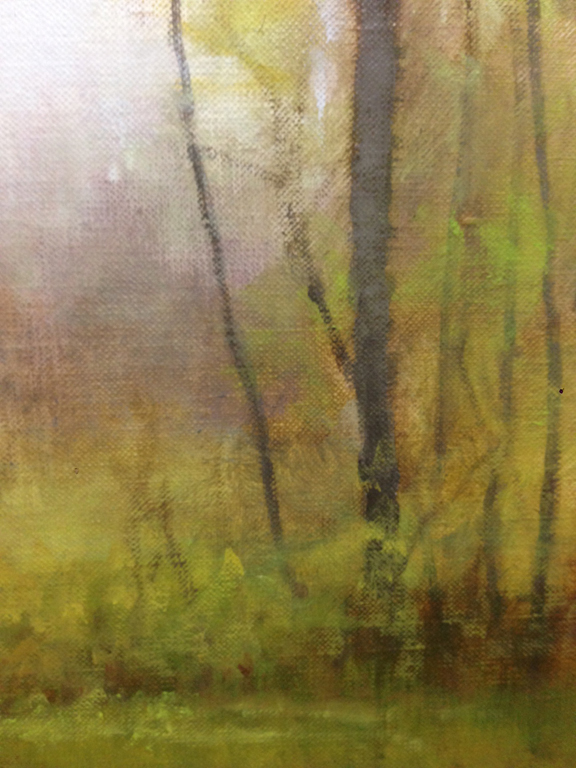
So, my idea here was to not follow my usual method of creating a background with multiple layers of scumbles applied with rags but to use more of a dry brush approach with more texture and opacity, but to try to make it read simultaneously as "air" but also decorative and somewhat flat. At the same time I wanted to continue with the challenge of face lit subjects and to also play with the idea of volume and flatness in those forms.


Aspen Grove Interior
39 x 33

Oddly, the "experimental" part of the painting seemed to go fairly well and I was happy with that part after a couple of passes.  Here are a few details.


But, the part that should have been easy- the foreground grasses- just would not come together. I had originally envisioned some dappled sunlight in this area but every configuration I tried ended up detracting from the "main event", so eventually, when I returned from my trip I eliminated it. As a result I repainted the foreground about 6 times. Luckily, although I lost the transparency as a result, the layers and shifts in temperature (which this image doesn't capture very well) made up for it. The more simple "light shade" of the foreground seemed a better fit for the image.

Thursday, May 7, 2015

New Work- Chroma is In the Midtones

This painting was started a year ago- either at the workshop or just after. The underpainting sat in my studio unfinished. Last summer I used it as a demo piece for the "scumble with rag" video I made (the back trees). Then it sat around again. With the coming of spring I felt inspired to work on it again. I was particularly interested in working with some of the concepts we have been studying in the Color II class and which I discussed in this post on the Field Notes blog - obviously vibration but also the idea that the mid tones can hold more chromatic color.

I lightened the value range from what I might typically do and tried to keep the color rich in the mid tones, while keeping the lights a little darker and the darks a bit lighter, narrowing the range. I am interested in exploring this further and am working on two other pieces now which include these ideas.


 Spring Morning II
24 x 18


Friday, December 6, 2013

What I learned in the Woods


Summer Respite
42 x 24
(click for larger view)

Now that I am closing in on finishing the work for the Lennox Woods show, I thought I might do a series of posts about what I have learned during this two year process. There are all sorts of things. I have learned a lot about my materials that I did not know. I have learned about patience and frustration. I have learned about the challenges of working on a large scale and of working on a long term project. The list goes on and on. So, I am going to tackle this one little piece at a time, and in no particular order of importance.

I have learned to slow down. To those who know me, I can hear your snorts of laughter! Yes, I do have a reputation for "being in a hurry, multitasking, getting a lot done in a short period of time and generally living by the "to do" list. But, exactly because of that, learning to slow down has been an important lesson, both in how I create my work and in how I approach it. Over the last ten years, the techniques I have adopted have necessitated that I slow down. Gathering field reference, eschewing photography and working indirectly have all made it necessary for the actual making of art to be a much slower process than it was when I was an alla prima, direct painter.

But now, I have slowed down in other ways. Spending time in the Woods has led me to a much slower, contemplative way of approaching Nature. Simply sitting on one spot and listening can lead to all sorts of things. In the end, that experience ends up on the canvas.

Sunday, November 10, 2013

Working on the "big boy"

One of the most exciting things about painting for my solo show next spring has been the opportunity to work in large formats. I have learned so much about how to go about this, mostly by trial and error. These days my studio is a jungle of easels and paintings, but I cleared away some of the clutter to show how I started this large painting, 72 x 96 , aka "big boy" which will be the centerpiece of the show.

I have described in another post how I use sketches, drawings, memory and imagination plus a study to start the process. A grid is made on tracing paper over the study and proportional squares placed on the larger canvas in charcoal. In this first image you can see the 18 x 24 study (which is at the underpainting stage) on the right, the grid in the middle, and big boy on the left with the charcoal grid laid in. All images can be clicked on for a larger view.


 Here is the grid. The main shapes and lines in the composition are traced in pencil after the grid format is drawn in in pen.


Here is the 18 x 24 study (unfinished).


Here is the underpainting more or less complete. This took about two days of work.


Up on my little stepladder working on the underpainting.


Sunday, September 30, 2012

Lennox Woods- Work in Progress

This is a painting I have had on the easel since early this year. It is the first of the larger works I am completing for my Lennox Woods solo show in 2014. At 48 x 64 it is the smallest of the six or seven large paintings I have planned to anchor the 50 piece exhibition. I completed the underpainting on this one early in the spring, but other things kept me from making any more progress on it until recently.

All of these images can be clicked for a larger view.

This is one of the value studies I did when working out the idea of the piece. This is graphite. At this point I am working out the design in the proportion I plan to use for the large canvas.

After deciding on a design, I did a monochromatic study in oil (again using the same proportion, 3:4)  Not a great image, a little glare. 18 x 24
Here is a grid on tracing paper. I laid the tracing paper over the oil study and drew a simple grid. This gave me some measuring points for placing the horizon and main forms on the larger canvas. I didn't draw a grid on the larger canvas because I really didn't need it but also because parts of my canvas will remain transparent in the final piece and I didn't want the grid to show. So, I just used the distances indicated by the grid (each 3" square would translate to a 8" square on the larger canvas) eyeballed it and measured using the proportions from the smaller study.

Here are the grid and the study on the easel next to the larger canvas.
Here is one days work on the larger canvas. 48 x 64. I lightly indicated where the horizon line was, the main tree shapes. Then I started using a wipe out method in the background using transparent paint (Vasari Shale) which was applied with a rag. The trunks will eventually be darker but at this stage I just wanted to get the placement organized. I started on the dry brush in the foreground before I stopped for the day. The toned triangular area in the foreground will eventually be covered with some opaque paint, then glazed (suggestions of leaf litter and forest floor clutter).
Unfortunately, I forgot to photograph the progress on the underpainting, but here it is completed. At this point I was beginning to change the direction of the light. Initially I had planned to have the light coming from the left and illuminating the main tree trunk. While I was working on the underpainting, I decided to change that plan and create a softer backlit scene. I also decided I wanted to open up the woods a bit more, creating more distance between the trees in the foreground and the trees in the distance. The underpainting is really the last opportunity to make those sorts of changes so I take my time and try to pay attention rather than just slavishly following my studies. 


Here is the piece after I have put a first layer of paint on the tree trunks in the foreground, a couple of layers of paint on the foreground, and also put in a first layer of paint in the sky and carved out some negative spaces in the distant trees


A detail of the near trees on the left side. These are American Hornbeams which abound in Lennox Woods. They have a distinctive fluted sort of trunk and are part of the understory trees throughout the Woods. This is just a first layer of paint. Many more to come.


Here is a detail of the sky and distant trees.


A detail of the main tree trunk, a white oak, in the foreground. Again, just the first layer of paint.


This is the foreground area depicting the forest duff- which is sometimes several feet deep in Lennox Woods!


I hope to have this piece finished by year end. Stay tuned!

Thursday, March 8, 2012

Little Everglades Ranch Workshop

I have just one spot left in this workshop which begins on March 26. Little Everglades Ranch is a beautiful pristine slice of "Old Florida" and a wonderful location for this class.

This five day class will focus on both work in the field and studio time, using sketches and studies to produce paintings in the studio. We will learn about indirect painting techniques like glazing , scumbles and velaturas which create luminosity and atmosphere in your works, study the works of past masters, learn about how to design more compelling finished works, and how a limited palette and and close value ranges can create a strong mood in your work.

Just one spot left. Join us for a fantastic week in Florida!

Here is the link for information and registration.


Thursday, September 1, 2011

Morning Light

Morning Light
24 x 30


As readers of this blog know, I am drawn to transitional times of day as the subject of my landscape paintings. For the most part, the evening hours have been my favorite subject. I love those brief moments when the day surrenders to the night. Although I walk at all times of the day, evening walks have always been my favorite. For the last four months though, I've been walking around dawn each day. I have to say, this time has inspired a new appreciation for the morning twilight hour.

This painting is based on a field about a mile from our property. The foreground shadow is mysteriously transparent, something which doesn't really show very well in the photograph. I've included a couple of details. You can get a larger view by clicking on them.

I used many many glazes on the foreground, creating suggestions of form within the shadows by subtle shifts in value and temperature. The road was laid in with thin opaque paint and then glazed over with the foreground glazes to bring it together and keep the value relationships correct. The lightstruck areas were created with thicker, lighter opaque paint.


The trees were laid in with several layers of transparent paint, then form was created with passages of velaturas and glaze impasto passages. Dry paint was dragged over some areas, and in some places the underpainting was left undisturbed.


The sky was painted with several layers of opaque paint and scumbled heavily in some areas. Scumbles were pulled over the trees in the distance to create atmosphere and the illusion of distance.


Sunday, October 26, 2008

Imagination & Execution

This past week I reread the book Art & Fear. I was first introduced to this wise little tome over ten years ago. Its one of those books that you can reread again and again, finding new and deeper insights each time. This time was no exception. The passages that seemed particularly apt had to do with what the authors call the "correspondence between imagination and execution"- that is, the place where your work actually gets made. The idea is that at the beginning the work can be whatever you can imagine but as it progresses- as you actually begin to make it- the possibilities narrow with each successive brushstroke, until at the end only a very narrow range of choices remain to complete the work. It is then its own thing, separate and apart from the world and what inspired it. In other words, as Annie Dillard (paraphrasing Paul Klee) wrote:

The painter...does not fit the paints to the world. He most certainly does not fit the world to himself. He fits himself to the paint. The self is the servant who bears the paintbox and its inherited contents.
I have read those words a dozen times over many years and have only just begun to understand what they mean. I had this ridiculous notion that I was in control!

This past week I've been working on the large painting-the underpainting is posted here. This first image is one glaze over the foreground and trees and the sky laid in with opaque paint.

Once the sky was laid in, I began to adjust the values and color temperature. It gets tricky here because you have to remember that each successive glaze will darken that portion of the panting. In this next image, I've put several more glaze layers on the foreground and the distant trees, repainted a portion of the sky, and adjusted the distant tree shapes and color harmony throughout.


So far, I've done very little to the large trees in the foreground and nothing to the small piece of water in the very front. And the sky will need repainting again. There are zillions of little adjustments to edges and shapes and color needed everywhere now-each needing to be fitted to what came before-to the paint.

Tuesday, August 26, 2008

Cool Water

Cool Water
oil on birch panel, 8x6

When I was a little girl I was, like many little girls, horse crazy. I started riding when I was about six and within a year had convinced my parents I had to have my own horse. During the school year, I rode in the afternoon and on weekends and in the summer I spent a good deal of my time on horseback exploring the fields, pastures and woods in north Florida where I grew up. There was a large pond (or at least it seemed large to me) on the edge of a pasture at the barn where I boarded my horse. After a ride on hot summer afternoons, I would strip off my horse's tack (and my own shoes and socks) and ride bareback with just a halter and rope into the pond. As we moved out to the center of the pond where the water was deepest, I would float like a leaf off my horse's back, holding on to his mane and the halter rope. His legs would begin to churn beneath me and the cool water from the bottom of the pond would rise up and envelop me. It was the most perfect sense of freedom I have ever known.

Friday, August 22, 2008

Creative Capital

Evening Pond
10 x 8
Please contact me if interested in this piece

You know how sometimes it seems like an idea keeps popping up everywhere in things you are reading, or looking at or thinking about? I've been thinking a lot lately about what I choose to paint- what ideas and imagery interest me and why. I wrote a bit about that here (quoting both Annie Dillard and Thoreau) and since then, it seems I find references to this notion- that your aesthetic sensibility is a like a vein of ore you are meant to mine. Then last week I was rereading The Creators by Paul Johnson, and there it was again- except this time Johnson had given it a name- creative capital.

"By experience I mean the combination of observation and feeling that leads to a creative moment...this precious capital can be spent- thrown away, as it were...and replenished by undergoing fresh experience...of an intense kind."

I'm not sure I would have agreed with that a few years ago, but now it seems just about right, at least for me. In my own case, I can't help but notice that certain imagery- water, for example- and certain times of day- evening, night- are favorite motifs. Although it was mostly an unconscious thing, I think the change in my painting techniques were directly related to my desire to explore these ideas. Perhaps the most dramatic change came about because of our move to a landscape which in many respects reminds me of the landscape of my childhood. There are powerful associations for me, childhood memories that I hadn't thought of in years-but which now seem to inform everything I want to paint.

"There are a lot of things I could say about the art (of poetry)....it should be about major adventures only,outward and inward-important things that happen to you, or important things that occur to you. Mere poeticality won't suffice."
Robert Frost 1928

I also think there is an edge of melancholy and sometimes a sense of sadness or loss in my work, that wasn't there until the last few years. Perhaps this is just an acknowledgment of the loss of my parents, who I miss terribly, and the fact of my own mortality. At 58, I am not exactly at death's door (at least, not that I know of, but I do feel a sense of urgency and mourn the loss of so many creative years when I was otherwise engaged.

"Write as if you were dying. At the same time, assume you write for an audience consisting solely of terminal patients. That is, after all, the case."
Annie Dillard, The Writing Life

But truth be told, I am not so sure I would have been able to tap into that vein 25 years ago or even 10 years ago. So perhaps this is my time and these are the things I was made to give voice to. One thing I know for sure, there's no time to waste.

Tuesday, July 1, 2008

Telluride Plein Air- Day 3

Morning at Leopard Creek
10 x 8

Leopard Creek is a small stream that runs north-south "down valley" as they say here in Telluride. I actually discovered it last year when I was here but never got a chance to paint it. So I headed there on the first day. The greens in the grasses are actually a bit cooler and more intense - the product of a last minute scumble with thinned cadmium green.

One of the many challenges of this week- in addition to the ones I mentioned in my last post- is integrating my "new" indirect painting method into plein air work. Plein air painting is an alla prima sport - the high wire act of painting. My strategy has been to do as many under paintings as possible the first couple of days, let everything dry, then glaze. Risky business since we have to have all our work ready by Thursday!

By the way, we are allowed to pre-sell all work so if anyone out there is interested in this piece, please contact me and I'll put you in touch with the Sheridan Opera Foundation (show sponsors) to complete the sale.

Saturday, May 31, 2008

Sunset Reflection


Sunset Reflection - 30 x 40 oil
Available at Hildt Galleries, Chicago
Sold

I've had the opportunity to work on some larger paintings these last few weeks. Its been a treat. Unfortunately, this image doesn't do the painting justice- the subtlety of the glazes in the foreground and changes in color temperature just don't register. Anyway, working large has been a goal of mine for several years but this is the first real opportunity I have had to paint this large in quite a while. It presents a whole new set of challenges , but I'm hooked! Now I'm dreaming of 48 x 60 or 60 x 90!

Tuesday, May 20, 2008

Afterglow


Afterglow - oil on canvas 24 x 30
Available at Hildt Galleries, Chicago

Here is the second painting of the "pair". I had planned to post them side by side but Blogger doesn't seem to want to let me do that. But, hopefully, they do read as complements to one another, as intended.

Thursday, May 8, 2008

Evening Sky


Evening Sky
10 x 10 Oil on panel
Please contact me if interested in this piece

The last few weeks I have been hit or miss, mostly miss, in my posting schedule. There are lots of good reasons- trying to get a group of larger pieces completed for my Chicago gallery and some personal stuff- but do feel guilty when I let it slide.

I've been having a problem lately with varnish. It seems like every time I varnish a painting I end up with lots of little bumps and debris on the surface that I didn't see before I varnished. I haven't changed varnish- I use Gamvar made by Gamblin- but I have changed my painting methods quite a bit and I've started using gessoed panels in addition to canvas. So I figured there was some technical voodoo at work. I went to the Studio Notes on the Gamblin web site for help. This is a great resource for painters- lots of technical information. I read their article on varnishing and then sent an email off with questions. Within 24 hours, as promised, I received a helpful email from Scott, who helped me pinpoint the problem (dust!) and gave some suggestions as to how to prevent or fix the problem. So today my husband constructed a little canopy under which my paintings reside while the glaze or varnish layers are drying- it was either that or build a new studio which is not in the same building as his shop. The canopy seemed like an easier solution. In addition to strictly technical advice, Studio Notes also has an interesting article comparing direct and indirect painting methods and the art historical context for those methods.

Friday, February 29, 2008

A Dispatch from the Bubble


My husband and I set out a year or so ago to simplify our lives and to create - as we call it - "the Bubble". This is the place (both geographical and internal) where we can do what we do in a simple, purposeful way. For me, that means painting and trying to mine the vein of visual ideas that the landscape suggests to me. I have talked a little about this here.

Writing this blog has become an unexpected part of the Bubble for me. In addition to the opportunity to connect with other artists all over the world, the small paintings I have produced and posted here became the seeds of ideas for larger works and even series of paintings. Because I was doing many of these little paintings rather than just a few larger ones, I was able to develop the ideas more quickly and also to adjust the technical changes that were occurring in my work more quickly. The change in my working process from direct painting to using indirect traditional methods like glazing also contributed to this- making it necessary to have several pieces going at once, rather than the simple start and finish approach I have always used before.

So what I am posting here are two beginnings - lay ins which are done in the manner I talked about here - of a series of 10-12 larger paintings now in progress. These are all based on the same visual idea, the seed of which is the small Rick's Pool paintings I posted over the last several months. Here in the Bubble we find this to be fascinating stuff, but I realize it may be less than compelling to you out there in the world. On the other hand, all artists I know have a pretty intense inner life going, so hopefully you'll forgive this little navel gazing glimpse into mine.

A rift in the time/space continuum of the Bubble occurs this weekend when we travel to Canyon, Texas for the opening of the Panhandle Plains Museum Invitational on Saturday. I have talked about the Museum and this show here, and am looking forward to the road trip, seeing the Museum again, and visiting with artist friends I know who will be there.