This little painting started as a demo in my recent workshop in Telluride. It will soon be headed to its new home in MA! Click for larger view.
Fallen
8 x 12
Here is the reference material I used. The drawing is one of several studies I did of the small blue spruce that seemed to be everywhere. The pen and ink drawing (dip pen, sepia ink and wash) was done on location. The stream was actually about 10 feet to the right…but I moved it.
I started the painting during the workshop to demonstrate the technique I use in my underpaintings. It was completed later after I got home from my reference drawings and memory.
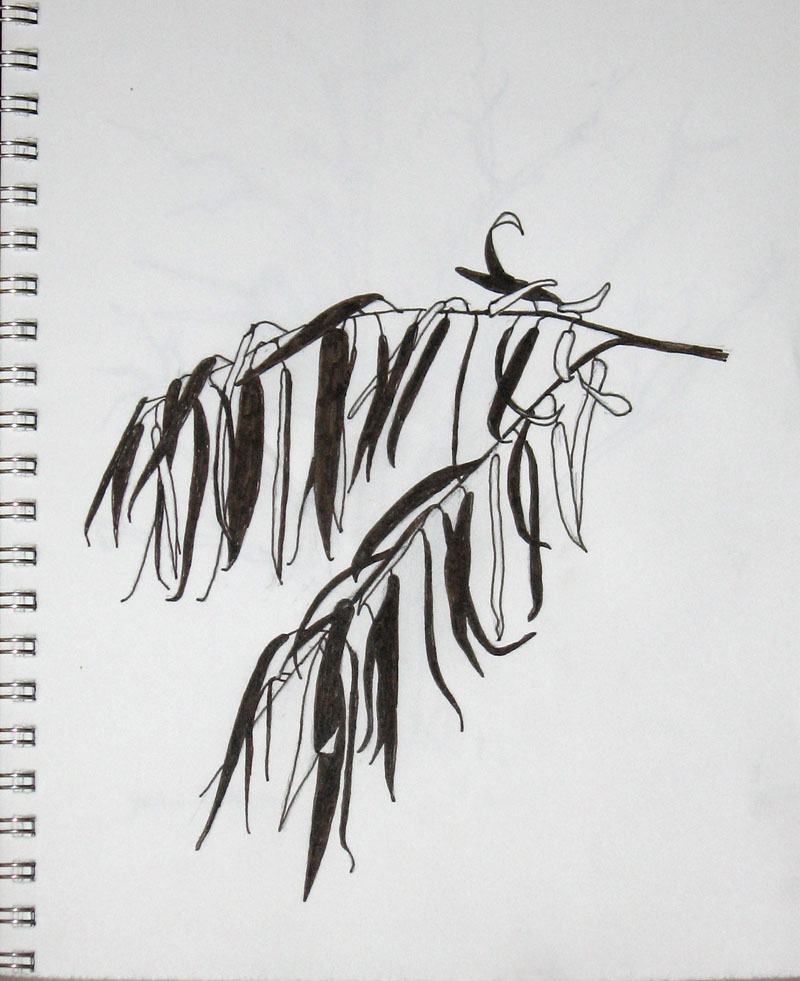
This past week I spent several days in a beautiful aspen grove. On about the third day I decided to do a study of an individual aspen tree. I noticed what I thought was an odd growth tucked between two branches. I got out my binoculars and discovered it was a broadtail hummingbird sitting on her nest! I spent a delightful couple of hours watching her as I worked on the drawing.
On my last day I spent a few hours doing a study of the trunk and branching of a ponderosa pine.
it's been a wonderful trip. I am headed back to Texas, but will return to Colorado in just a few weeks to teach a workshop in Telluride.
With cold temperatures and an ice storm just this week, it is hard to imagine that spring is just around the corner. But, it is! So, it's time to start thinking about painting and drawing outdoors.
Field Sketching I and II online classes are coming up in April and May, just in time to kick off a great season of work outdoors!
Working from Nature and direct observation is the time honored way to learn how to paint landscapes. Unfortunately, many aspiring landscape painters miss the essential first step: learning to draw and sketch in the field. If you are unable to draw the landscape you will have a much more difficult time learning to paint it convincingly.
Most classes and workshops jump into plein air painting without giving students any tools to make a success of their efforts. This course is designed to give you the tools to draw and sketch in the field with confidence, both improving your plein air paintings and leading to better, finished work in the studio.
This year I reorganized my online class schedule to better fit the course to the time of year. In the past, classes were added when a need seemed to arise and as a result some students in colder climes found themselves struggling to work outdoors. As a result, The Painted Sky is being offered again this summer (having just been taught in February). Summer is, of course, a glorious time to go skying. Recently when I was looking through some old portfolios of drawings I came across these pastel cloud studies done in the summer of 2001 in Santa Fe. I wrote about The Summer of Santa Fe here. It made me smile to see them and think of those big New Mexico skies once again. Pardon the skewed cell phone photography.
The Painted Sky Online Class
July 26- August 23, 2013
For landscape painters, painting a believable sky means creating a sense of distance, atmosphere, light, and mood. This course is designed to give students the knowledge and techniques to paint beautiful atmospheric skies.
In this course we will cover:
~ gradation of colors in the sky at various times of day
~ gradation of values in the sky
~ types of cloud formations and how to depict them
~ use of atmospheric and linear perspective to create believable skies
Online classes are a great way to study at a slower, measured pace and on your own schedule. Participation is limited to ten students, so there is plenty of individual attention. To learn more about how these classes work, click here.
Many students find this way of learning to be challenging, effective and convenient. In any given class I may have students from throughout the US as well as Canada, the UK and Europe, so it makes for a lively, interesting learning experience. Click here to read what students have to say. And registration is here.
The online class Field Sketching for Landscape Painters begins March 8. Whether you are new to working outdoors or an experienced plein air painter, this course will get you ready for the spring and summer season!
Working from Nature and direct observation is the time honored way to learn how to paint landscapes. Unfortunately, many aspiring landscape painters miss the essential first step: learning to draw and sketch in the field. If you are unable to draw the landscape you will have a much more difficult time learning to paint it convincingly. Most classes and workshops jump into plein air painting without giving students any tools to make a success of their efforts. This course is designed to give you the tools to draw and sketch in the field with confidence, both improving your plein air paintings and leading to better, finished work in the studio.
Topics covered will include:
~drawing materials and techniques ~a history of field sketching and study of examples of 19th century field sketches (drawings, watercolors and oils) ~how to do close studies of elements in Nature, value studies and thumbnails sketches ~how to use field sketching to gather reference material for studio work (and reduce your dependence on the camera!). ~how to use field sketching to aid in working from memory and imagination Not sure that an online class is right for you? Click here to read what students say!
I've just updated the schedule for online classes for the remainder of 2012 and for winter/spring 2013. Due to a reschedule of classes this fall, I still have a couple of spots left in the Composing the Landscape Class which starts on November 16. You can get more information about all the classes and register here.
I am happy to say that my spring workshop scheduled for April 6-13, 2013 is about half full. The Landscape Atelier is an eight day workshop designed to provide students with a start to finish methodology for creating luminous landscapes, based on observation of Nature, drawing and sketching in the field, design and composition, to underpainting, and indirect painting techniques in the studio. Information about this exciting workshop opportunity and registration is here.
This is a painting I have had on the easel since early this year. It is the first of the larger works I am completing for my Lennox Woods solo show in 2014. At 48 x 64 it is the smallest of the six or seven large paintings I have planned to anchor the 50 piece exhibition. I completed the underpainting on this one early in the spring, but other things kept me from making any more progress on it until recently.
All of these images can be clicked for a larger view.
This is one of the value studies I did when working out the idea of the piece. This is graphite. At this point I am working out the design in the proportion I plan to use for the large canvas.
After deciding on a design, I did a monochromatic study in oil (again using the same proportion, 3:4) Not a great image, a little glare. 18 x 24 Here is a grid on tracing paper. I laid the tracing paper over the oil study and drew a simple grid. This gave me some measuring points for placing the horizon and main forms on the larger canvas. I didn't draw a grid on the larger canvas because I really didn't need it but also because parts of my canvas will remain transparent in the final piece and I didn't want the grid to show. So, I just used the distances indicated by the grid (each 3" square would translate to a 8" square on the larger canvas) eyeballed it and measured using the proportions from the smaller study.
Here are the grid and the study on the easel next to the larger canvas. Here is one days work on the larger canvas. 48 x 64. I lightly indicated where the horizon line was, the main tree shapes. Then I started using a wipe out method in the background using transparent paint (Vasari Shale) which was applied with a rag. The trunks will eventually be darker but at this stage I just wanted to get the placement organized. I started on the dry brush in the foreground before I stopped for the day. The toned triangular area in the foreground will eventually be covered with some opaque paint, then glazed (suggestions of leaf litter and forest floor clutter). Unfortunately, I forgot to photograph the progress on the underpainting, but here it is completed. At this point I was beginning to change the direction of the light. Initially I had planned to have the light coming from the left and illuminating the main tree trunk. While I was working on the underpainting, I decided to change that plan and create a softer backlit scene. I also decided I wanted to open up the woods a bit more, creating more distance between the trees in the foreground and the trees in the distance. The underpainting is really the last opportunity to make those sorts of changes so I take my time and try to pay attention rather than just slavishly following my studies.
Here is the piece after I have put a first layer of paint on the tree trunks in the foreground, a couple of layers of paint on the foreground, and also put in a first layer of paint in the sky and carved out some negative spaces in the distant trees
A detail of the near trees on the left side. These are American Hornbeams which abound in Lennox Woods. They have a distinctive fluted sort of trunk and are part of the understory trees throughout the Woods. This is just a first layer of paint. Many more to come.
Here is a detail of the sky and distant trees.
A detail of the main tree trunk, a white oak, in the foreground. Again, just the first layer of paint.
This is the foreground area depicting the forest duff- which is sometimes several feet deep in Lennox Woods!
I hope to have this piece finished by year end. Stay tuned!
This past month, Allen Phillips filmed an interview in the studio for the Lennox Woods Project. So, click on over and take a look!
I have a few spots left in my Field Sketching for Landscape Painters online class which starts May 25. Here's a description of the class:
Working from Nature and direct observation is the time honored way to learn how to paint landscapes. Unfortunately, many aspiring landscape painters miss the essential first step: learning to draw and sketch in the field. If you are unable to draw the landscape you will have a much more difficult time learning to paint it convincingly. Most classes and workshops jump into plein air painting without giving students any tools to make a success of their efforts. This course is designed to give you the tools to draw and sketch in the field with confidence, both improving your plein air paintings and leading to better, finished work in the studio.
Topics covered will include:
~drawing materials and techniques ~a history of field sketching and study of examples of 19th century field sketches (drawings, watercolors and oils) ~how to do close studies of elements in Nature, value studies and thumbnails sketches ~how to use field sketching to gather reference material for studio work (and eliminating your dependence on the camera!). ~how to use field sketching to aid in working from memory and imagination
This week in my online class Field Sketching for Landscape Painters we are using pen and ink and wash techniques. This has been a favorite sketching medium of artists for centuries and it is ideally suited for landscape work. Both Rembrandt and Corot used it to great effect and we've studied examples of their work as well as 19th century American artists like William Trost Richards.
This was done in an area called Lennox Woods, an old growth hardwood forest about 6 miles from us. It is one of the few remaining areas like this in the state and this one is particularly diverse given our location in the far northeastern corner of Texas. The Lennox family preserved it and gave about 300 acres to the Nature Conservancy. The forest is part of the Pecan Bayou watershed. I am working on a series of paintings inspired by Lennox Woods so I am over there a lot sketching.
I used a dip pen with a Hunt #512 nib, india ink and a small brush to apply the washes. The drawing is on Arches cold pressed watercolor paper. All images can be clicked for a larger view.
We are in week 2 of my online class Field Sketching for Landscape Painters. The idea for this class came from two of my students who expressed concerns about their drawing skills and the challenges of working outdoors. One of the things I have noticed over the many years I have painted plein air and taught plein air painting is that most students are not really ready to take on the rigors of outdoor work. Most do not have the drawing skills, but those who do, fair much better. That combined with my interest in 19th century landscape painters and their working methods, led me to design a course which would give students some basic skills in drawing the landscape as an important prerequisite to painting it.
Our text for the class is John Ruskin's The Elements of Drawing which was so influential for American landscape painters in the 19th century. Combining Ruskin's drawing exercises with other assignments, students are building drawing skills for creating form, understanding value, and learning to slow down to appreciate and understand Nature as artist/naturalists. Here is some of their work.
Caroline Simmill, Moray, Scotland
Ash tree- Ruskin exercise Caroline Simmill
Brian McGurgan, Astoria, NY
Ruskin exercise Bea Lancton, Fredericksburg, TX
Ruskin exercise Jamie Kirkland, Santa Fe, NM
Ruskin exercise Jamie Kirkland
Jan Delipsey, Dallas, TX
copy of Wm. Trost Ruchards drawing Phoebe Chidester, Clearwater, FL
I am in the midst of teaching my online class The Painted Sky. It's a wonderful time of year for it- the big cumulus clouds are building up in the afternoons, and the heat and humidity are creating wonderful hazy light and spectacular sunsets. I've also been doing some field research on sketching methods for my new online class Field Sketching for Landscape Painters which I'll be teaching this fall.
As part of my classes and workshops, I always include some art history and use both contemporary and historical examples to demonstrate concepts we are learning. In the case of this new class, my goal is to give students some basic information and tools to study Nature in the field and gather reference material for studio works. So many aspiring landscape painters are simply taken outdoors to paint without any preparation, drawing skills, or basic knowledge of composition and values. In fact, this is the standard model, such as it is, for training for landscape painters today.
If we go back and look at how landscape painters learned their craft and art in the 18th and 19th centuries, we will see that a rich tradition of drawing and sketching was undertaken in the field, both in close studies of individual elements like trees, rocks and plants and general sketching of compositions. Painted studies followed these efforts. So, I try to incorporate these methods in my teaching, providing not only techniques but examples of these works.
This study started with a simple thumbnail sketch of a sky observed in my backyard.
Using toned paper was a well known technique for making sky studies in the late 18th and 19th centuries. The paper creates a value for the sky and midtones, shadows and highlights can be created with the black and white charcoal and white pastel. It is particularly well suited for cloud studies. Here's a detail of the drawing. All of the images can be clicked on for a larger view.